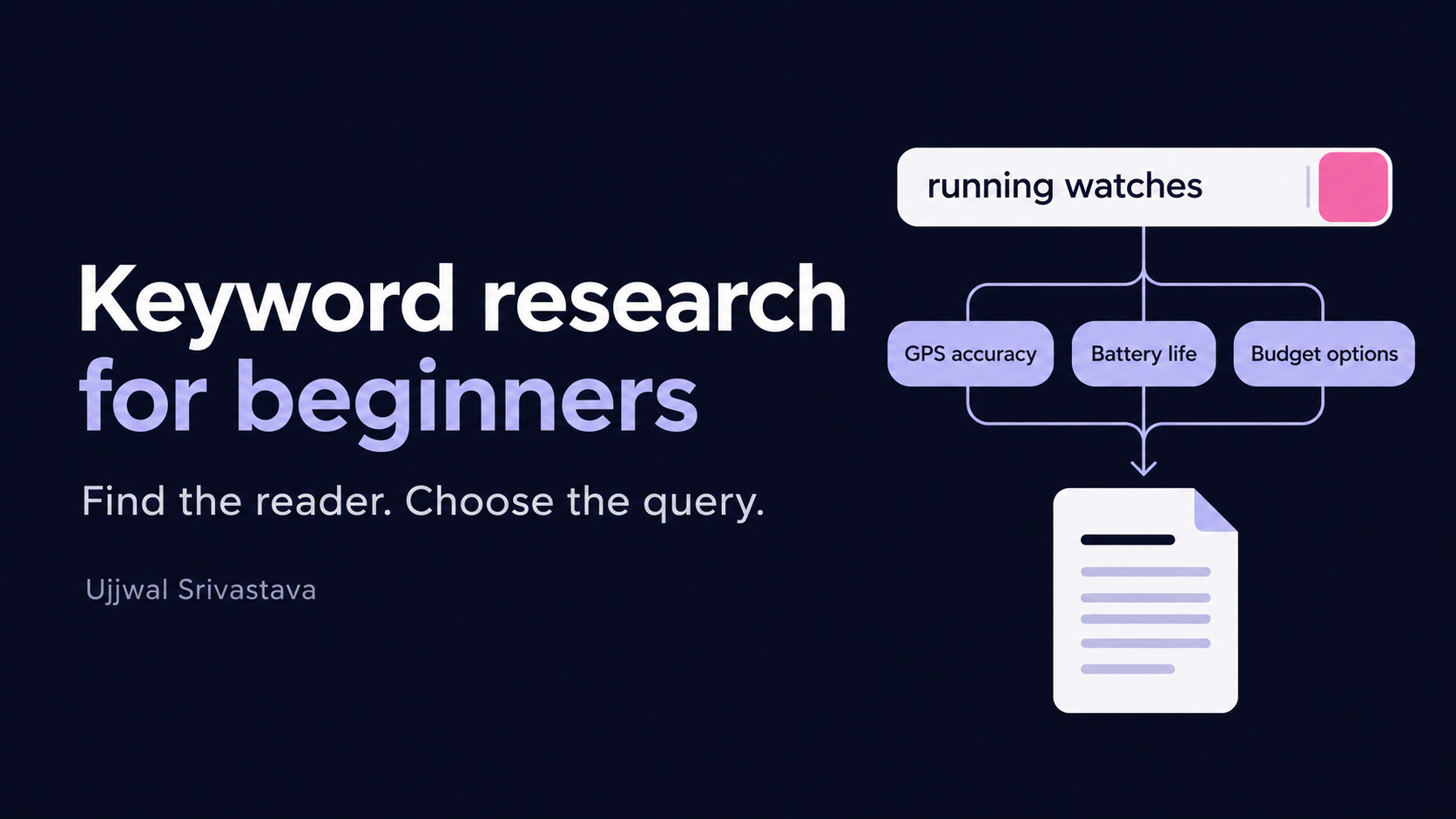
Keyword research is the process of finding and evaluating the words and questions people use in search engines. It helps you decide which searches your content should address. It connects an article idea to an actual reader need.
A keyword can be a single word, a phrase, or a complete question. “Running,” “GPS running watches,” and “which running watch works without a phone?” are all examples. A useful keyword can take any of these forms.
Before you open a keyword tool, think about what you are helping someone do. That single choice shapes every keyword you collect, every section you write, and whether the finished article earns the reader’s attention or wastes it.
How to do keyword research in 2026: TL;DR
- Keyword research is how you find the exact phrases people type into search engines and decide which ones your content should target. It connects an article idea to a real reader need.
- Before you open any tool, know who you are helping and what they need to do. That single decision shapes every keyword you collect.
- Check three things for every candidate: search volume, search intent, and organic competition. Together they tell you whether a keyword is worth pursuing.
- A primary keyword is a planning tool. One clear phrase keeps your article focused. Supporting keywords cover the same reader need from different angles.
- Long-tail keywords aren’t automatically easy. Specificity narrows the audience but doesn’t guarantee low competition.
- Free tools are enough to start. Google Keyword Planner, Google Trends, and Ahrefs’ free generator cover the basics before you need to pay for anything.
- AI can cluster and organize your keyword list. Use supplied tool data or connected sources for demand estimates, verify the output against those sources, and make the final decision yourself.
What are primary and secondary keywords?
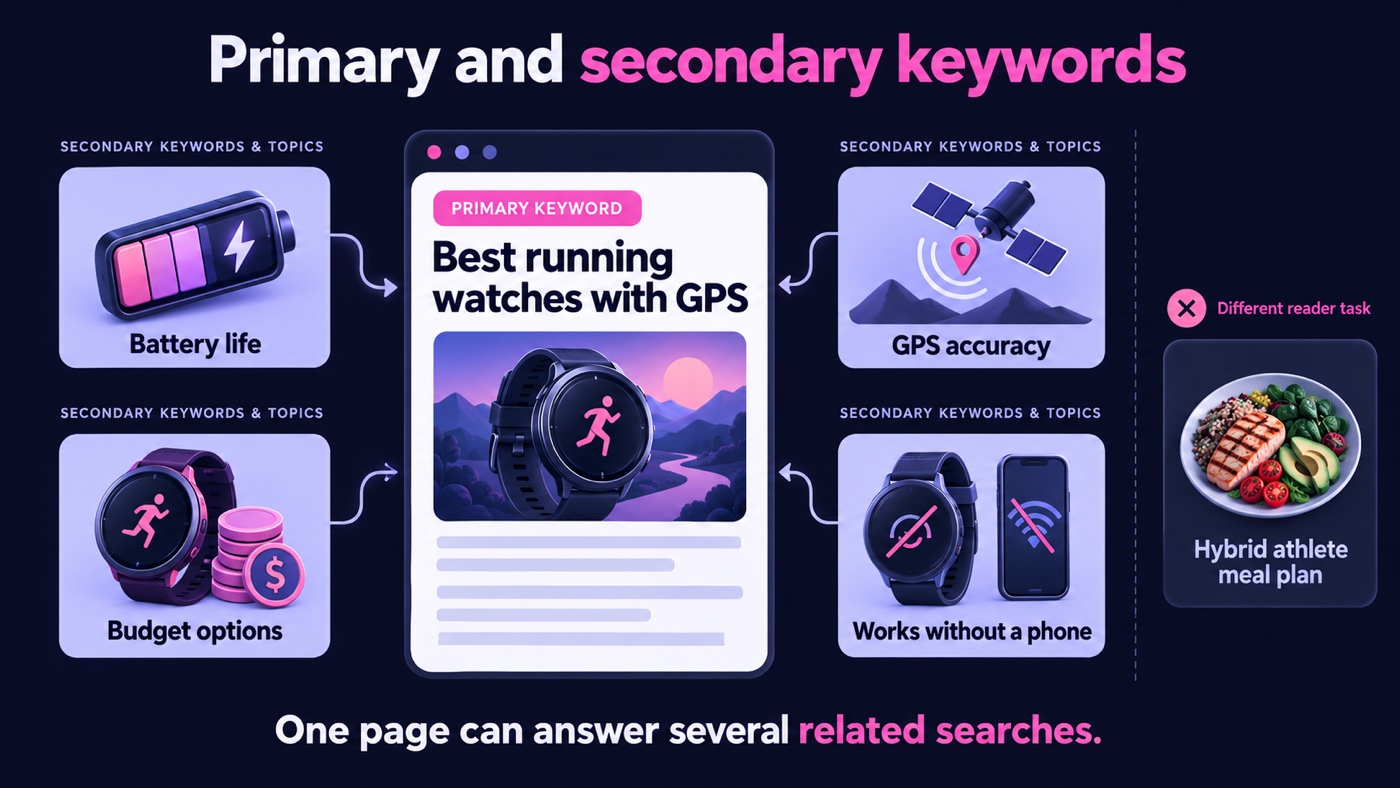
A primary keyword represents the main search query you want a page to address, while secondary keywords are related phrases and questions that help you cover that topic. Together, they give the page a clear focus without restricting it to one exact wording.
For a comparison article, an illustrative primary keyword could be “best running watches with GPS.” Supporting topics might include battery life, GPS accuracy, budget options, and whether a watch records a run without a phone. These support the same decision: which watch should the reader choose?
A keyword’s role depends on the page. “Best budget GPS running watches” could support a broad roundup or become the primary keyword for a dedicated budget guide. You need to inspect the search results and decide whether that narrower topic needs a separate page.
I use one primary keyword as a planning aid. It keeps the article’s main promise clear. It doesn’t mean the finished page can appear for only one search phrase.
The practical test is whether each supporting topic helps the intended reader. Adding “hybrid athlete meal plan” to a watch comparison would stretch the article into a different subject, even though both topics involve fitness.
What is the difference between broad and long-tail keywords?
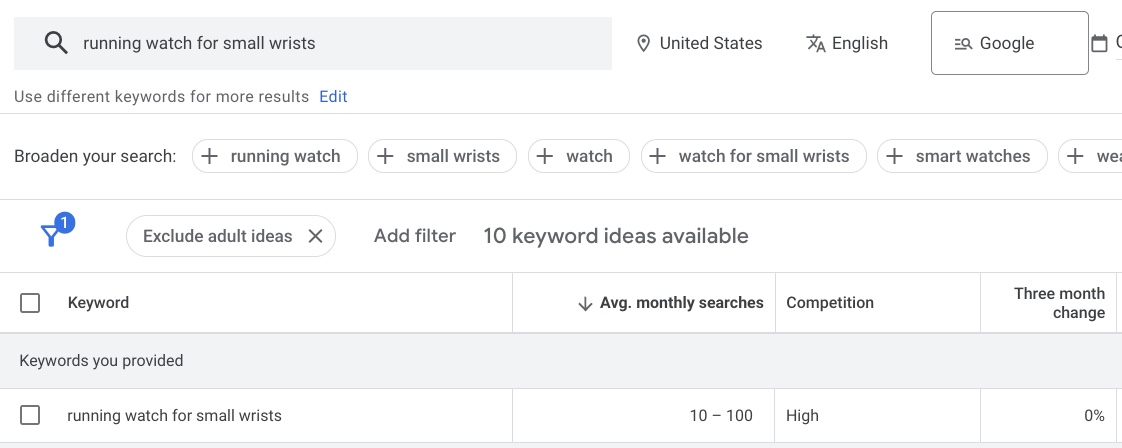
Broad keywords cover a large topic with high search demand (“running watches”), while long-tail keywords describe a more specific need with lower demand (“running watch for small wrists”), though word count alone doesn’t define either. A short phrase can have little demand; a longer one can be popular.
Specificity also doesn’t guarantee low competition. A detailed query about an expensive product can still attract strong retailers and specialist publishers. For beginners, the better question isn’t “is this long-tail?” It’s “can I answer this need well?”
What should beginners check before choosing a keyword?
Beginners should check search volume, search intent, and organic competition. Volume helps estimate demand. Intent explains the searcher’s goal. Organic competition helps you judge the pages your content would compete against.
Use these questions to assess an idea:
| What to check | Question to ask | What it can’t tell you |
|---|---|---|
| Search volume | How often is this searched in my target market? | How many visitors my article will receive |
| Search intent | What does the searcher want to learn, find, compare, or do? | That everyone using the query has the same goal |
| Organic competition | What would it take to compete with the existing results? | That a low difficulty score guarantees a ranking |
Start with relevance. A popular keyword is still a poor choice if it serves the wrong audience or needs a page you can’t provide.
What is search intent?
Search intent is the goal behind a search query. It explains whether someone wants to learn something, reach a specific destination, compare options, or take action. Understanding that goal helps you choose the right page and the right information.
Query wording provides a clue, but search results provide more evidence. Look at whether Google shows guides, comparisons, official websites, product pages, or a mixture before deciding what a query needs.
Search intent falls into four types: informational, navigational, commercial, and transactional. A query can carry more than one, but most searches lean clearly toward one goal.
Informational intent
The searcher wants to understand a concept or answer a question. Answer the main question before explaining related ideas. A definition shouldn’t require three paragraphs of background to become visible.
- Example: “What is a hybrid athlete?”
- What the searcher wants: A clear explanation of the concept
- Suitable response: A definition-led guide that covers training approaches and context
Navigational intent
The searcher wants to reach a specific destination. An independent article is unlikely to complete that task as directly as the destination itself. Brand names alone don’t settle intent, since “Garmin watches” could also signal browsing or shopping.
- Example: “Garmin official website”
- What the searcher wants: The exact page or brand they already have in mind
- Suitable response: The official website itself
Commercial intent
The searcher wants help making a decision. Recommendations should explain their basis. If you have not tested a product, don’t present desk research as firsthand experience.
- Example: “Best running watches with GPS”
- What the searcher wants: Meaningful differences between options
- Suitable response: A buying guide that covers price, battery life, size, and compatibility
Transactional intent
The searcher wants to take action, usually a purchase. An educational introduction adds friction when someone already knows what they want to do.
- Example: “Buy Garmin Forerunner 265”
- What the searcher wants: A direct path to completing the purchase
- Suitable response: A product or retailer page with price, availability, and purchase terms
How do you assess organic keyword competition?
Assess organic competition by inspecting the pages that already appear for your target query. Check their format, relevance, evidence, and usefulness. A keyword difficulty score can support this review, but it shouldn’t replace reading the results.
First, separate two different meanings of competition. Google Keyword Planner’s competition column measures advertiser competition. It doesn’t measure how hard it is to rank an unpaid article.
SEO tools offer their own organic difficulty estimates. For example, Ahrefs explains that its KD score uses referring domains linking to the top 10 organic results and excludes on-page SEO factors. Other tools use different methods. A score of 25 in one tool isn’t automatically equivalent to 25 elsewhere.
Here is what I would inspect manually:
- Page format: Are the results mostly product pages, buying guides, or tutorials? That tells you whether your planned article fits the task. If you want to publish a blog post but the results largely serve shopping needs, reconsider the query or the page you intend to create.
- Evidence and usefulness: Do the leading articles explain their recommendations, demonstrate relevant experience, and help readers make a decision? Identify what you could substantively contribute. A longer version of an existing list isn’t necessarily an improvement. More useful evidence or clearer comparisons would give you a stronger reason to publish.
- Specific gaps: Look for unanswered questions, unclear explanations, missing comparisons, or outdated details that affect the reader’s task. Check whether those gaps matter to the intended audience. A missing section is an opportunity only if adding it makes the page more useful, rather than simply making it longer.
Don’t make the mistake I made when I started out. A weak-looking result doesn’t mean you can replace it. Check the effort it would take and whether your page actually fits the task before you commit.
Is keyword density important when planning keywords?
Keyword density describes how often a keyword appears relative to a page’s word count. It isn’t search demand, and it shouldn’t guide your choice of primary or secondary keywords.
Google says it has no notion of an optimal keyword density. Its spam policies also warn against filling pages with keywords to manipulate rankings.
So I would not write a running-watch article while counting how many times I have repeated “best running watches with GPS.” I would use the phrase where it makes the topic clear and describe the watches naturally elsewhere.
Specific details help the reader more than forced repetition. Explain battery modes, phone requirements, or how the comparison was conducted. Don’t replace useful information with another occurrence of the keyword.
Which free Google tools help with keyword research?
Google Keyword Planner, Google Trends, Google Search, and Google Search Console help with different parts of research. Use Keyword Planner for demand estimates, Trends for changes in relative interest, Search for suggestions and intent checks, and Search Console for an existing website’s performance.
| Tool | Best beginner use | Main limitation |
|---|---|---|
| Google Keyword Planner | Generate ideas and check search-demand estimates | Its competition column concerns ads |
| Google Trends | Compare interest over time and investigate seasonality | Its index isn’t monthly search volume |
| Google Search | Inspect page formats and discover related questions | Suggestions don’t provide numerical demand |
| Google Search Console | Find queries that already bring visibility to a site you manage | It isn’t a market-wide or competitor keyword database |
If you prefer to learn by watching, each of these tools has a solid beginner tutorial:
- How to use Google Keyword Planner: Find the Best Keywords for Your Business (2026 Guide)
- How To Use Google Trends For SEO & Google Rankings
- How Google Search Works (in 5 minutes)
- Google Search Console Tutorial (2026): The Complete Guide
How do you research keywords and choose a primary keyword?
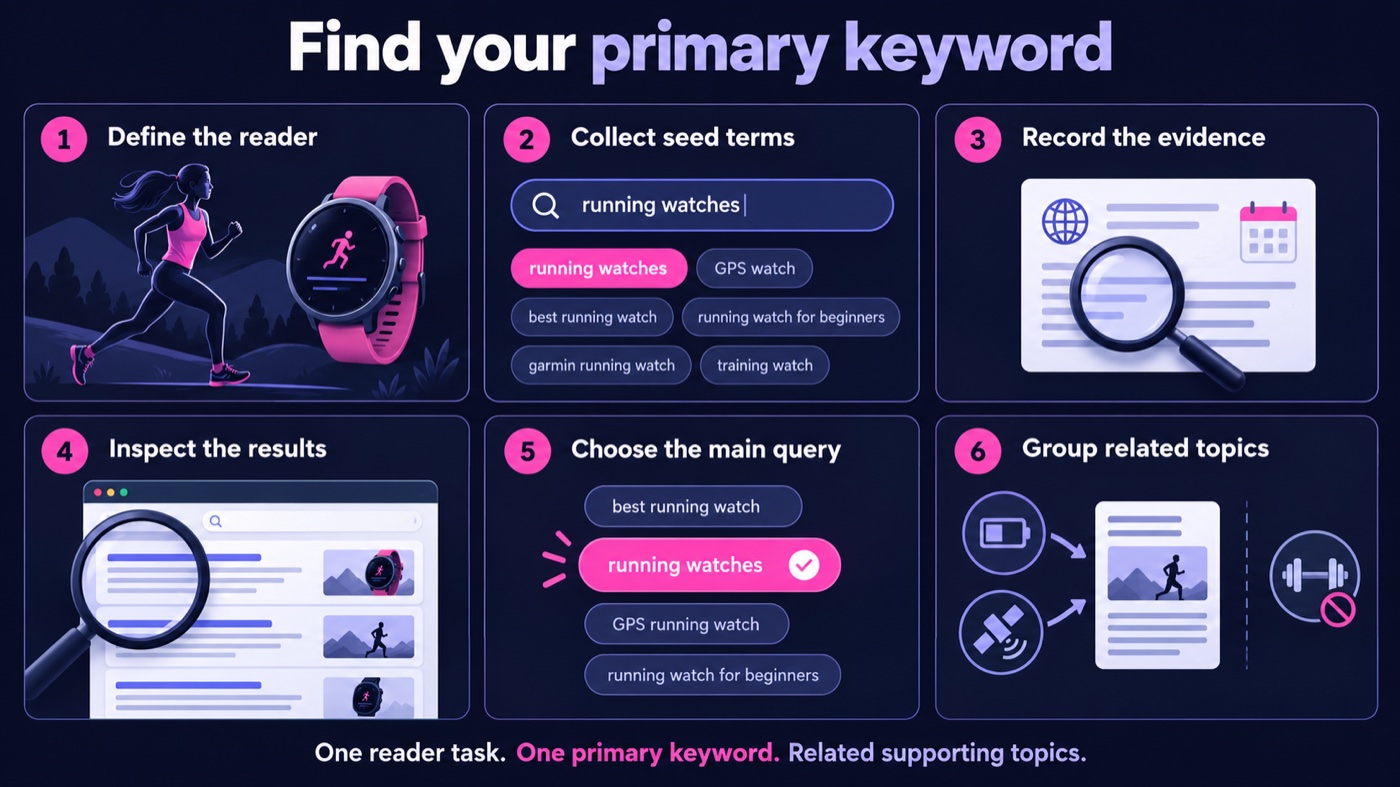
Choose a primary keyword by identifying the reader’s task, collecting relevant queries, checking demand, and inspecting the search results. Then select the phrase that best represents the page you can create. Keep supporting terms that help answer the same need.
Here is how I would work through the running-watch example:
- Define the reader: Decide who the article helps before opening a keyword tool. “Runners choosing their first GPS watch” gives you a clearer direction than “people interested in fitness.” It also helps you judge which details matter, such as whether the watch needs a phone or how much it costs.
- Start with seed terms: Enter a few relevant phrases such as “running watches” and “GPS running watches.” Collect useful suggestions without accepting every result. An unfamiliar phrase might reveal a real question, but an awkward phrase doesn’t automatically deserve to become your title just because a tool displays it.
- Record the evidence: Save the reported volume or range, country, date range, and data source beside each candidate. Keep advertiser competition in a clearly labeled column if you retain it. Put organic difficulty estimates in a separate column with the tool name so that you don’t confuse the two.
- Inspect the results: Search the most promising candidates and examine the visible page types. Read leading pages rather than stopping at their titles. For a buying guide, investigate what decision criteria they cover, what evidence supports their recommendations, and what your intended reader might still struggle to understand.
- Choose the main query: Select a phrase that matches the article’s central promise. For our illustrative comparison, “best running watches with GPS” is a possible primary keyword. It remains a candidate until you check actual demand and results. The example isn’t a claim that this phrase has low organic competition.
- Group supporting topics: Keep phrases that help the same reader make the same decision. Battery comparisons may fit naturally. A detailed hybrid athlete training program probably needs its own article. When two terms appear to need different pages, compare their search results before combining them into one outline.
You can start with a small shortlist. You don’t need to collect a thousand terms to plan one useful article.
How do you decide which secondary keywords belong on the same page?
Keep secondary keywords together when they support the same reader task and can be covered properly within one page. Separate them when they need a different format, audience, or depth of explanation. Shared words alone are not enough to justify grouping.
The following is an illustrative content map. It contains no verified search-volume or difficulty figures.
| Candidate phrase or topic | Possible treatment | Reason |
|---|---|---|
| Best GPS running watches | Possible close variation | Similar comparison task, subject to a results check |
| Running watch battery life comparison | Supporting comparison | Helps readers assess options |
| Cheap GPS running watches | Budget section or separate guide | Depends on scope and whether results indicate a distinct need |
| Best GPS watch for marathon running | Use-case section or separate guide | May need more specialized comparison criteria |
| How GPS running watches track distance | Short explanation or separate explainer | Include only the detail needed for the buying decision |
| Garmin Connect login | Exclude as a target | The reader wants a known destination |
| Hybrid athlete strength training split | Separate article | The task is training design, rather than choosing a watch |
Notice that some decisions remain conditional. I treat it as part of the research. A keyword list should help you make decisions, rather than hide uncertainty behind a confident label.
If the same pages repeatedly appear for two candidate phrases, that can support combining them. If the results serve noticeably different tasks, investigate separate pages. There is no need to turn that observation into a rigid universal overlap percentage.
How to use Claude for keyword research?
Feed Claude your raw Keyword Planner export and ask it to group keywords by reader goal, flag ambiguous terms for a manual search-results check, and suggest one primary keyword per page. Treat the output as a draft. Check that it preserves the supplied metrics, adds no unsupported figures, and groups terms around the same reader task.
Starting with real data from Google Keyword Planner
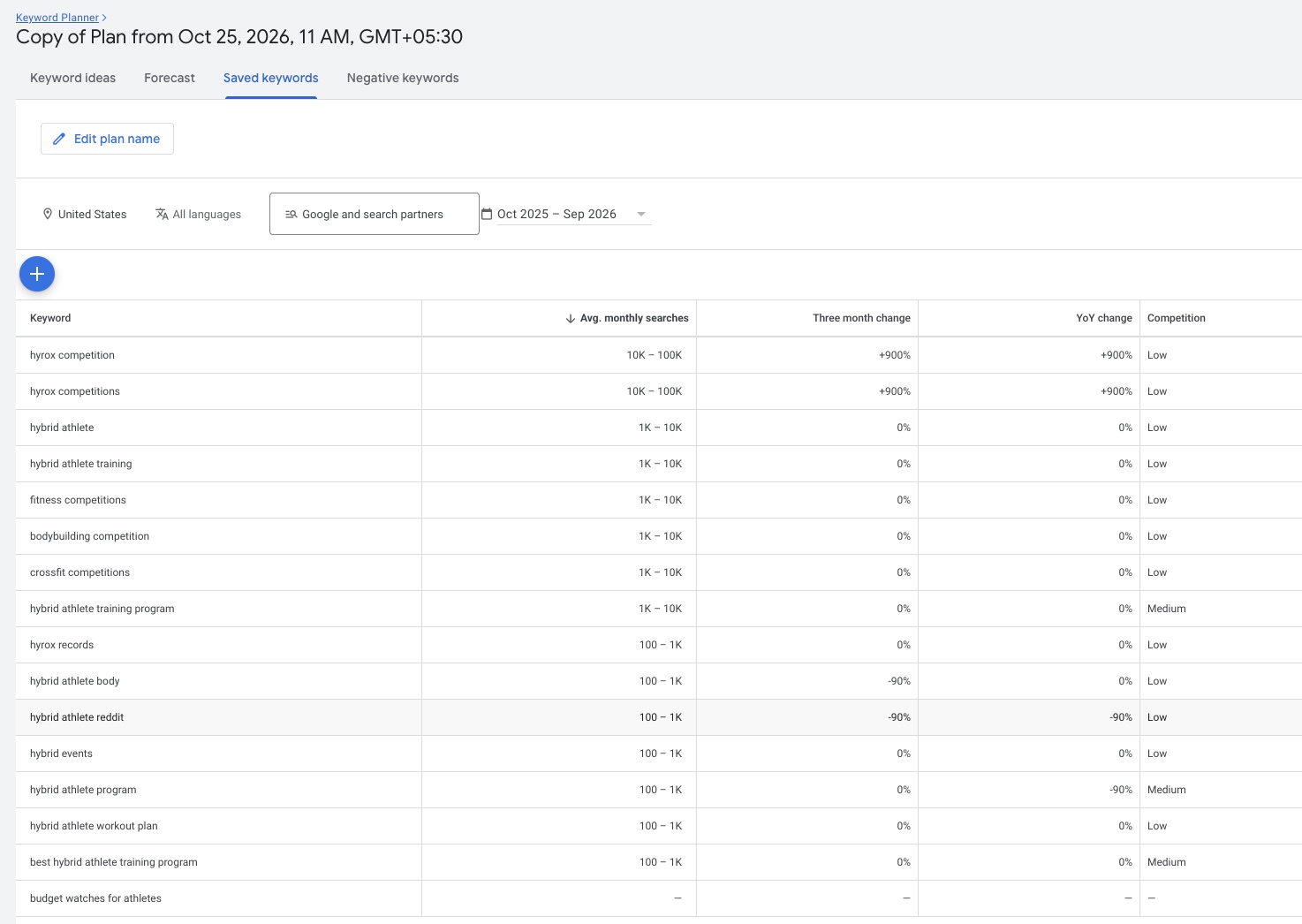
While preparing my Udemy course on AI content writing, I researched keywords for hyrox and hybrid races. I pulled 16 keywords from Google Keyword Planner (United States, all languages, Google and search partners, October 2025 to September 2026).
“hyrox competition” and “hyrox competitions” both showed 10K-100K average monthly searches with a +900% three-month change and +900% YoY change. Treat a sharp increase as a reason to investigate. Check the monthly pattern, relevant event dates, search intent, and competing results before deciding whether to prioritize the topic.
Other terms, including “hybrid athlete,” “hybrid athlete training,” and “fitness competitions,” showed ranges of 1K-10K with 0% change. These terms showed steady reported demand. They could support this article or become primary targets for separate pages, depending on the reader’s task and the search results.
“hybrid athlete body” and “hybrid athlete reddit” both showed a -90% three-month drop. Before deciding whether to target those terms, inspect a longer period in Google Trends and consider relevant event dates. A short-term decline alone doesn’t establish seasonality or a lasting reversal.
“Budget watches for athletes” had no Planner data at all, which doesn’t mean nobody searches it. It means this export didn’t estimate that term. Check the SERP manually before writing it off.\
What I gave Claude and what it returned
The prompt I used:
Group this keyword list by the reader’s goal. Suggest one primary keyword for each possible page and identify supporting subtopics. Preserve the supplied metrics and their sources. Flag ambiguous cases for a manual search-results check. Don’t invent volumes, difficulty scores, rankings, or new data. Explain why each group belongs together.
Claude returned four keyword groups, each with a reader goal, a primary keyword, supporting terms, a page structure suggestion, and flagged ambiguities.
The most useful output was Group 1, Hyrox events, where Claude proposed grouping “hyrox competition” and “hyrox competitions” on one page. Their similar wording makes this a reasonable starting point, but I would confirm the grouping by comparing search intent and overlapping results.
Google Keyword Planner includes close variants in its search estimates, so identical metrics alone don’t prove that two pages would compete.
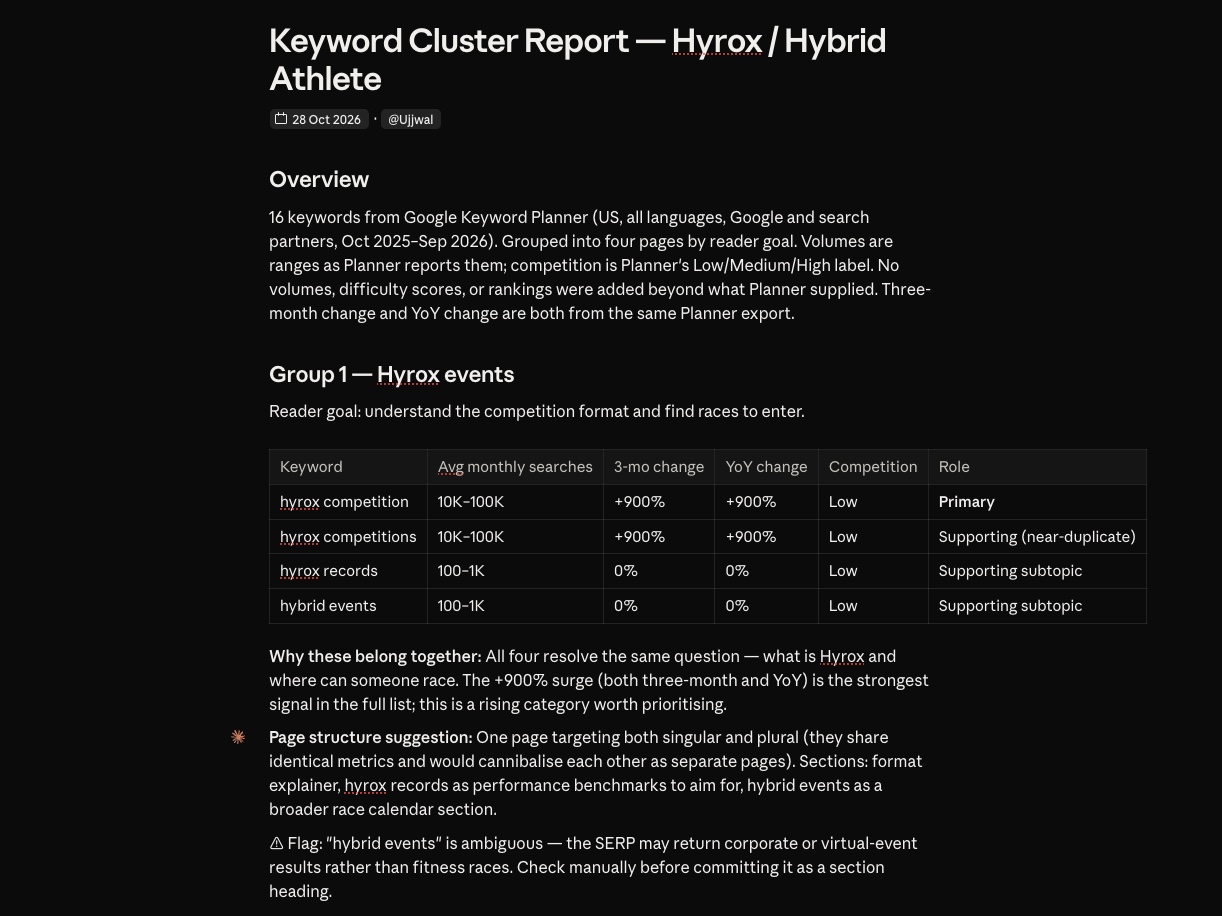
It also flagged “hybrid events” as ambiguous because the SERP might return corporate event results rather than fitness races. That saves you from building a section around a keyword that doesn’t mean what you think it means.
The brief it helped me build
Using that cluster report, I wrote this article: What is a Hyrox competition? Format, workouts, and rules explained
Primary keyword: hyrox competition. Reader goal: understand the format and find races to enter. The page covers the format explainer, Hyrox records as performance benchmarks, and hybrid events as a race calendar section. That structure came from the cluster report and my own SERP analysis. For your own brief, record the search date, target market, leading page types, and why each proposed section belongs on the page. A format explainer, performance records, and a race calendar may need separate pages if the results show different reader tasks.
Run your Planner export through the same prompt.
Before you paste it in, add one line at the end:
For each primary keyword candidate, I will manually add the top 3 organic competitors. Leave a bracketed placeholder [Competitors: ] after each primary keyword row so I can fill it in after checking Google.
Then search each primary keyword yourself, note who ranks in positions 1 to 3, and add them into the prompt output. That one extra step turns a keyword group into a competitive brief you can actually write from.
What keyword research mistakes should beginners avoid?
Beginners should avoid choosing keywords from volume alone, confusing ad competition with organic difficulty, and forcing unrelated phrases into one page. The research should clarify what to write and why it serves the reader.
Check these points before drafting:
- Use the right metric: Search volume measures demand estimates. Keyword density concerns repetition within a page. Advertiser competition concerns ads. Organic difficulty is a tool’s estimate of ranking competition. Keeping those meanings separate prevents a misleading number from driving your topic choice.
- Check the actual task: Don’t decide intent from one word or a software badge alone. Review the results and consider possible mixed intent. A model name can lead to reviews, specifications, and shopping. A useful article needs a clear task even when the original query is ambiguous.
- Keep examples honest: Don’t label a phrase “easy,” “high-converting,” or “seasonal” without evidence. Illustrative running keywords explain a process; they don’t prove a market opportunity. The same applies to testing claims. Only describe firsthand experience when you actually have it and can explain what you did.
- Protect the page’s focus: You don’t need a separate heading for every keyword variation or a separate article for every synonym. Add a section when it helps the reader. Split a topic when it needs its own treatment. An outline should follow the questions, rather than the order of rows in a spreadsheet.
Free tools I recommend for your keyword research
I didn’t use a paid tool when I started, and you don’t need one either. The concepts in this guide (search volume, intent, and competition) work the same regardless of what’s in your toolbar. Pick one or two tools, learn what their numbers actually measure, and add more only when you have a specific reason to.
- Google Keyword Planner: demand estimates and keyword ideas. Requires a Google Ads account with completed setup, including billing information
- Google Trends: relative interest over time and seasonality
- Google Search Console: performance data for sites you own
- Ahrefs Free Keyword Generator: keyword ideas with basic difficulty estimates
- Ubersuggest: keyword suggestions and limited competitive data
- Semrush Free Plan: keyword overview and limited daily searches
- Keyword Surfer: volume estimates directly in Google Search results, browser extension
FAQs related to search and keyword research
What is Google Keyword Planner and how do you use it?
Google Keyword Planner is a free Google Ads tool that generates keyword ideas and shows search demand estimates for a selected market. Google currently requires completed account setup, including billing information, to access basic keyword-idea features. Start with a seed term, select your target country, and collect relevant suggestions.
What does Google Trends tell you about keywords?
Google Trends shows whether interest in a topic is rising, falling, or seasonal. It uses a 0-100 scale that represents relative interest. Use it to spot patterns an annual average would hide, like whether demand for a topic spikes around a particular season or event.
How do Google Search suggestions help with keyword research?
Google’s autocomplete and People Also Ask results show how real people phrase their needs. They’re useful for finding subtopics and question angles, but they don’t come with volume data. Treat them as idea prompts, not a ranked keyword list, and only keep suggestions that actually serve your article’s purpose.
What is Google Search Console used for in keyword research?
Search Console shows how a site you manage already performs in Google Search, including which queries bring impressions and clicks. It’s useful for finding questions your existing content partially answers or pages with declining click-through rates. It only works for sites you own or have access to and won’t show competitor data.
How do you turn keyword research into an article outline?
Once you have a primary keyword and a set of supporting topics, convert the main reader questions into sections. The primary keyword defines the page’s promise. Group related questions into sections, and use H2s, H3s, tables, or short paragraphs based on what each needs. Order them the way a reader would naturally ask them. Answer every heading immediately in the opening sentence of that section.